How Freelancers Get Paid: Compare Payment Methods and Fees
Compare freelance payment methods by country support, client convenience, total fees, currency conversion, withdrawal, and payment risk.

Use this freelance contract checklist to clarify scope, revisions, payment, ownership, confidentiality, delays, and project cancellation.
A useful freelance contract says who is hiring whom, what you will deliver, what is outside scope, when the client must respond, how revisions and changes work, when payment is due, who owns the work, and how either side can end the project.
This checklist is educational, not a contract for every country or project. Contract, tax, employment, consumer, privacy, and intellectual-property rules vary. Use a qualified lawyer for high-value, regulated, cross-border, or unusual work.
| Contract section | Question it must answer | Common failure |
|---|---|---|
| Parties and authority | Who is legally entering the agreement? | The invoice name does not match the contracting company |
| Scope and deliverables | What exactly will be delivered? | “Website” means ten pages to one side and thirty to the other |
| Timeline and dependencies | What is due, and what must the client provide? | Client delays consume the freelancer’s schedule |
| Revisions and changes | What is included, and how is extra work approved? | Unlimited revisions hide inside a fixed price |
| Payment | How much, when, in which currency, and by what route? | Fees, deposits, and overdue invoices are undefined |
| Intellectual property | Who owns or may use each part, and when? | Payment and ownership are assumed to mean the same thing |
| Confidentiality and data | What must be protected, where, and for how long? | The freelancer receives data they cannot safely store |
| Pause and termination | How can the project stop, and what is still payable? | A cancellation leaves completed work unpaid |
Use the legal names and contact details of the freelancer and client. If the client is a company, record the company name and the person authorized to approve scope and payment. A brand name in an email signature may not be the entity that should appear on the contract and invoice.
State whether you are acting as an individual, sole trader, or company. Confirm where formal notices should be sent. If a procurement team issues a purchase order, make sure it matches the agreement rather than quietly replacing your payment or ownership terms.
“Design a website” is not a usable scope. Name the pages or templates, responsive breakpoints, integrations, content responsibility, browser support, source files, testing, migration, training, and launch support that are included. For writing, list article count, approximate length, research, interviews, images, upload, and revision rounds.
Add an exclusions paragraph. It can be short: hosting, paid fonts, stock media, translations, legal review, ongoing maintenance, and new features are excluded unless listed. Exclusions are not hostile. They stop different assumptions from becoming an argument.
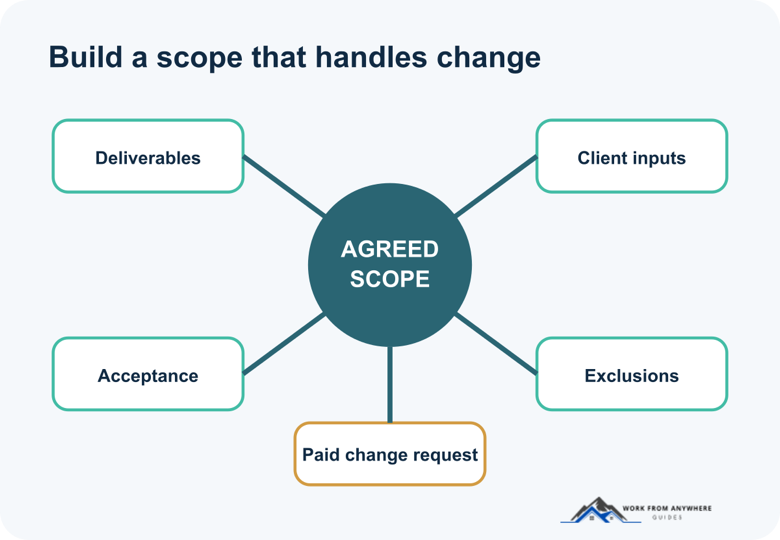
List the start date, milestones, delivery target, and client review window. Then state which dates depend on receiving the deposit, brief, content, account access, feedback, or approvals. A fixed calendar deadline is risky when the freelancer cannot control the client’s inputs.
Explain what happens after a delay. The schedule might move by the length of the delay, or the project may return to the next available slot. For retainers, say whether unused hours expire, roll over, or require written approval.
Define how the client accepts work and how long they have to review it. “Approved by email” is clearer than “when the client is satisfied.” For technical work, acceptance may depend on listed tests. For creative work, it may mean approving a named concept or deliverable.
State how many revision rounds are included and what a round means. A round can cover one consolidated list of changes to the agreed deliverable. A new page, audience, feature, or direction is a change request, not a revision.
Use the client communication guide for practical wording when feedback, delays, or scope changes appear.
The contract should allow either side to suggest a change without making every conversation a new legal negotiation. Require a written description, price or rate, schedule effect, and approval before extra work begins.
Work outside the listed deliverables will begin only after both sides approve the added scope, price, and schedule in writing.
That sentence is a plain-language starting point, not jurisdiction-specific legal drafting. Its job is to create a pause between a request and unpaid work.
Record the fee, currency, deposit or milestones, invoice timing, due date, payment method, taxes, transfer charges, and what happens when payment is late. If the project is hourly, define the rate, minimum billing unit, reporting cycle, and any weekly or project cap.
For fixed-price work, connect payments to milestones the client can recognize. Avoid leaving nearly the entire fee until final delivery when the project lasts for months. If you use a non-refundable reservation fee, late charge, or collection-cost term, confirm it is enforceable where the contract applies.
Before quoting, run the hours, direct costs, revision buffer, platform fee, and payment charges through the freelance project calculator. The guide to freelance payment methods covers the path from invoice to bank account.
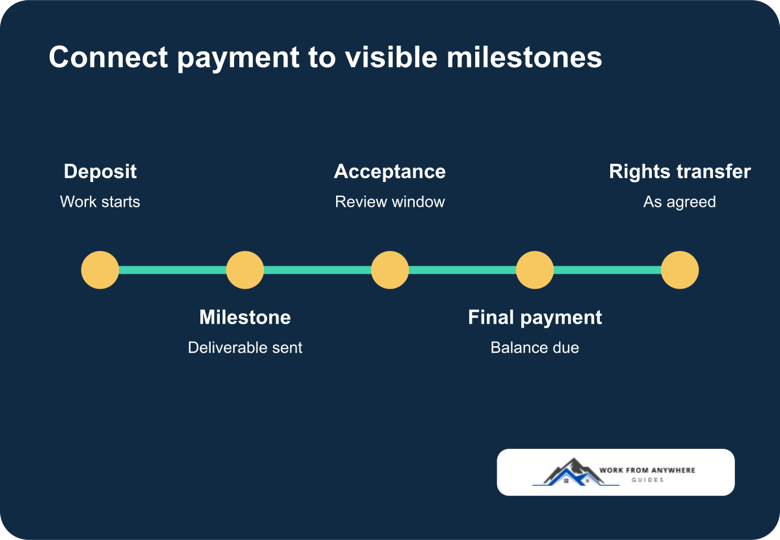
Payment for a file and ownership of copyright are not automatically the same thing. The agreement should distinguish the final deliverables from the freelancer’s existing tools, templates, code, methods, fonts, stock assets, and third-party material.
Decide whether the client receives ownership, an exclusive licence, or a non-exclusive licence, and for which uses, territories, and period. If ownership transfers, state whether transfer happens on creation, delivery, or full payment. Keep a licence for portfolio display only if both sides agree and confidentiality permits it.
Official rules differ. UK Intellectual Property Office guidance says a freelancer or independent contractor will usually retain copyright unless the contract says otherwise. US law also treats ownership and “work made for hire” as specific legal questions; the US Copyright Office explains that a copyright transfer generally must be written and signed.
For valuable software, branding, publishing, or media rights, get local legal advice. Copying an American “work for hire” clause into a contract governed elsewhere may not produce the result either side expects.
Define confidential information, permitted use, who may access it, how long obligations last, and normal exclusions such as public information or material already known. If personal or regulated data is involved, identify approved systems, storage location, deletion, incident reporting, and any required data-processing agreement.
Do not promise security controls you do not operate. Ask the client to provide the approved account rather than sending shared passwords. The remote-work security guide covers safer accounts, updates, backups, and access.
State how much notice either side must give, what happens to work in progress, what remains payable, and when access or client property is returned. A cancellation fee or “kill fee” can cover reserved capacity and work completed before the client stops the project, but its wording and enforceability depend on local law.
Add a pause rule for missing feedback or payment. Explain when the project becomes inactive and what is required to restart. Otherwise a client can disappear for three months and expect the original deadline the day they return.
Pay close attention to indemnities, unlimited liability, broad warranties, non-compete terms, exclusivity, penalties, insurance requirements, governing law, and dispute venue. A small project should not casually expose a freelancer to unlimited losses or litigation in a distant country.
A contract label does not decide whether someone is legally an independent contractor. For example, the US IRS says the actual right to control what is done and how it is done matters. Worker classification is jurisdiction-specific, so get advice when the relationship resembles employment.
Put the date and version on the agreement. Make sure both sides sign the same document before work starts. Save the signed contract, proposal, change approvals, invoices, delivery records, and acceptance messages together. If the parties use an electronic-signature service, retain its audit record.
Do not start because the client says procurement will “sort the contract later.” If timing is urgent, reduce the first commitment to a small paid discovery phase with its own clear terms.
A contract should make the next difficult conversation easier: what is included, what changed, what is due, and what happens if the project stops. If a clause moves risk you cannot price or understand, pause and get local legal advice before signing.

Compare freelance payment methods by country support, client convenience, total fees, currency conversion, withdrawal, and payment risk.
Leave a Reply
Comments