Freelance Contract Checklist: Scope, Payment, Revisions, and IP
Use this freelance contract checklist to clarify scope, revisions, payment, ownership, confidentiality, delays, and project cancellation.

Compare freelance payment methods by country support, client convenience, total fees, currency conversion, withdrawal, and payment risk.
For a direct client, a local bank transfer is usually the simplest route when both sides use the same country and currency. Cross-border work needs another check: can the service accept the client’s payment, hold or convert the currency you need, and withdraw to your bank at a reasonable total cost?
Do not choose a payment method from one headline fee. Compare the entire path from the client’s account to your usable bank balance, including receiving, conversion, withdrawal, intermediary-bank, and card fees.
| Method | Usually fits | Main cost to check | Main risk |
|---|---|---|---|
| Local bank transfer | Clients and freelancers in the same banking system | Account or transfer charges | Weak payment protection and slow tracing |
| International bank transfer | Large invoices where both sides already use SWIFT | Sender, intermediary, recipient, and conversion fees | The received amount may be lower than expected |
| Wise Business | Supported freelancers receiving local account transfers in several currencies | Account-detail, conversion, SWIFT, and route-specific fees | Features and currencies vary by registered country |
| Payoneer | Marketplace payouts and eligible cross-border client payments | Receiving method, currency corridor, withdrawal, and inactivity-related charges | The general pricing page may differ from your account’s exact fees |
| PayPal or card payment | Clients who value a familiar checkout | Commercial, cross-border, fixed, and conversion charges | Disputes, chargebacks, holds, and country restrictions |
| Freelance marketplace | New client relationships that benefit from platform payment protection | Platform service fee and withdrawal route | Protection depends on following the platform’s rules |
Availability and fees were checked on August 20, 2026. Payment providers change pricing by country, currency, account type, and payment route.
Start with four facts: where the client is, where your account is registered, the invoice currency, and the bank account where you need the money. A method that works well for a US client paying a US freelancer may be unavailable or expensive for a freelancer in Pakistan, India, Nigeria, or the Philippines.
Ask the client how their accounts-payable team normally pays contractors. A bank transfer may be easy for them. A card link may be faster for a small business. A large company may require vendor onboarding before it can pay either way. Solve that before work begins, not after the invoice is overdue.
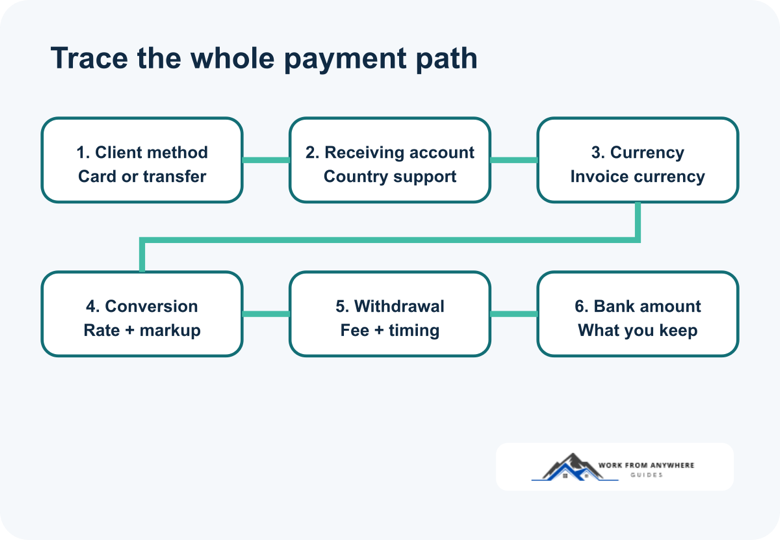
A domestic bank transfer is hard to beat when it is cheap, traceable, and familiar to both sides. Put the account name, banking details, invoice number, amount, currency, and payment deadline on the invoice. Confirm whether the client needs a tax form, purchase-order number, or vendor record first.
International wires can involve more than the sending bank. Correspondent or intermediary banks may deduct charges before the payment reaches you. Ask whether the transfer instruction will be marked so the sender pays all fees, fees are shared, or the recipient pays them. The labels and availability differ by bank, so the client should confirm the option with their bank.
For a small invoice, a fixed wire fee can be painful. For a large invoice, a bank transfer may cost less than a percentage-based card payment. Compare a normal invoice amount instead of assuming one method always wins.
Wise Business can provide account details in supported currencies, allowing eligible customers to receive certain payments through local bank networks. Wise says receiving domestic payments is free for most supported currencies, with exceptions including USD wires, while international SWIFT receipts can carry fees. Converting currency also has a route-specific fee.
The important word is eligible. Account details and business features depend on where the business is registered and which currencies are supported there. Wise also says a business registration or account-detail fee applies in some regions. Check the exact country view and the account screen before promising a client a payment route.
Use Wise when the client can make a normal transfer to your available account details and the final conversion and withdrawal path works for you. Do not recommend it to a client only because another freelancer in another country uses it.
Check Wise’s official pages for business fees, account-detail eligibility, and receiving fees and limits.
Payoneer is familiar to many freelancers because marketplaces and business platforms can pay into it. It also supports receiving accounts and client payment requests for eligible users. Its published fees vary by the payer’s method, the sender and recipient countries, currencies, and withdrawal route.
Payoneer’s January 2026 pricing page lists different charges for payments from another Payoneer balance, local or non-local receiving accounts, cards, ACH, EU or UK bank accounts, currency conversion, and bank withdrawal. Some account types or regions can also have an annual plan or fee. The amount displayed in your account is more reliable than a generic comparison table.
Payoneer makes the most sense when it is already connected to the marketplace or business paying you, or when its receiving and withdrawal route is clearly available in your country. Review Payoneer’s current official fee page before accepting the method.
A familiar card checkout can remove friction for a client. It can also add a percentage fee, a fixed fee, a cross-border charge, and currency conversion. PayPal’s commercial rates vary by market, account, transaction type, and currency, so use the fee page for your registered country rather than copying a US rate into a global comparison.
Stripe can power card payments and payment links in supported countries. Its global availability page is the first check: accepting cards from customers worldwide does not mean Stripe accounts are available to businesses in every country. Country-specific pricing matters too.
Card payments also introduce chargeback risk. Keep the signed agreement, invoice, scope changes, delivery records, and client approval in one place. Payment convenience does not replace evidence that the work was requested and delivered.
Verify PayPal merchant fees for your market, plus Stripe’s supported countries and country-specific pricing.
A freelance marketplace can be worth its service fee when the client is new and the platform provides funded milestones, time records, dispute procedures, or payment handling. That value disappears if you accept payment outside the platform, start before a milestone is funded, or fail to submit work through the required workflow.
Read the current platform rules before beginning. Keep messages, files, scope changes, and approvals inside the permitted system when payment protection depends on them. The guide to freelance job boards and platforms compares where this protection exists and what it costs.
Suppose the invoice is $1,000. Method A charges a fixed $20 plus a small bank conversion spread. Method B charges a percentage to accept the payment, then another conversion cost. Method C looks free to receive but charges more on withdrawal. The useful number is not the first fee. It is the final amount in your bank account and the time it took to arrive.
Use the freelance project calculator with your normal invoice amount. Add platform fees, payment fees, fixed charges, direct costs, and a realistic exchange rate. Then compare the take-home amount under two or three routes.
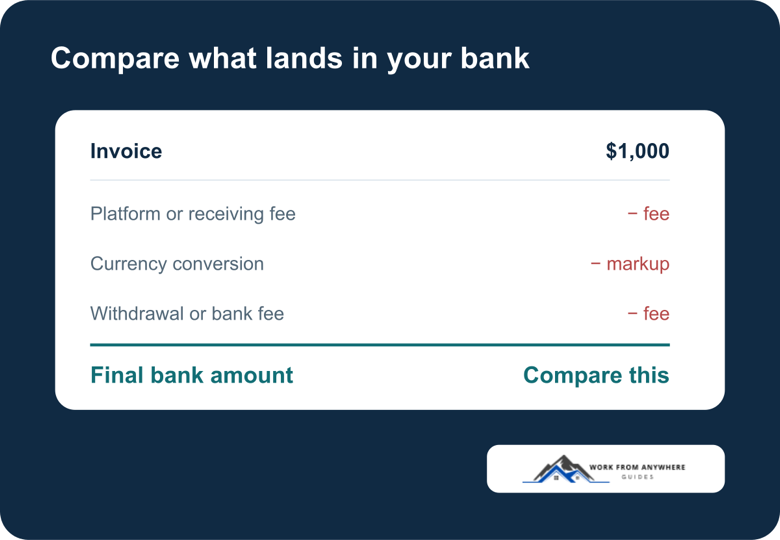
Your proposal or contract should name the currency, payment method, deposit or milestone, due date, and who covers transfer charges. State what happens when the client changes the payment route after accepting the quote. For recurring work, confirm whether each invoice uses the exchange rate on the invoice date, payment date, or another agreed reference.
Send a test invoice or small first milestone before moving a large project onto an unfamiliar account. Never return an accidental “overpayment” to a different account, buy gift cards for a client, share a one-time login code, or pay money to unlock a supposed incoming transfer.
The invoicing-software guide covers recurring billing and reminders. For currency decisions, use the guide to exchange rates and freelancer income.
Choose the route that works for both sides and leaves a predictable amount in your bank. Confirm it before the project begins, write it into the agreement, and test unfamiliar payment paths with a smaller amount when practical.
Use this freelance contract checklist to clarify scope, revisions, payment, ownership, confidentiality, delays, and project cancellation.
Leave a Reply
Comments