Freelance Contract Checklist: Scope, Payment, Revisions, and IP
Use this freelance contract checklist to clarify scope, revisions, payment, ownership, confidentiality, delays, and project cancellation.

Exchange rates can shrink freelance income through conversion spreads, transfer fees, and forced payouts. Here is how to invoice with fewer surprises.

The number you see in a currency converter is usually a reference rate, not a promise of what will reach your bank. A cross-border payment can lose value at several points:
Do not compare providers by the headline transfer fee alone. Compare the amount that arrives in the currency you actually spend.
Here is a hypothetical example. The numbers are deliberately simple and do not describe a particular provider.
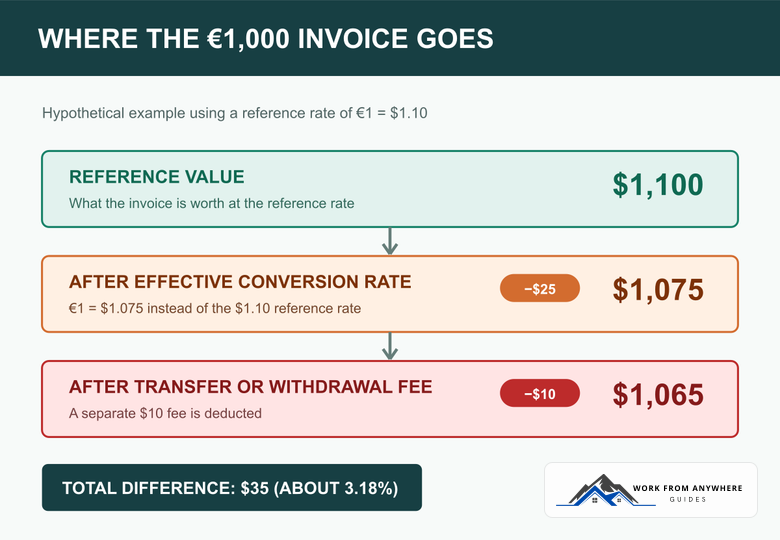
You invoice a client for €1,000. The mid-market reference rate at the time is €1 = $1.10, so the reference value is $1,100.
Your payment provider uses an effective conversion rate of €1 = $1.075. After conversion, the balance is $1,075. A further $10 transfer or withdrawal fee leaves $1,065 in your bank account.
| Step | Amount | Difference from reference value |
|---|---|---|
| Reference value at €1 = $1.10 | $1,100 | $0 |
| Value after the provider's effective rate | $1,075 | -$25 |
| Amount after a $10 transfer fee | $1,065 | -$35 |
The total difference is $35, or about 3.18% of the $1,100 reference value. That does not automatically make the provider expensive. The route may include convenience, speed, card processing, payment protection, or easier client approval. But you should know the real cost before setting your price.
The effective exchange rate tells you what happened after the provider's conversion cost. Divide the amount received before any separate withdrawal fee by the original invoice amount.
Effective rate = converted amount ÷ invoice amount
In the example, $1,075 divided by €1,000 gives an effective rate of 1.075. Compare that with the reference rate available at roughly the same time. The gap includes the provider's exchange-rate margin and any conversion charge already built into the quoted rate.
Some services separate the conversion fee from the exchange rate. Wise's conversion guidance, for example, says it uses the mid-market rate and charges a conversion fee that varies by currency. Other providers may include a currency-conversion spread in the transaction rate. PayPal's US merchant-fee page, for instance, states that applicable conversion rates include a spread. The exact pricing depends on the account, route, country, payment method, and date, so check the official quote for your own transaction.
Price the project before currency conversion. Use the freelance project calculator to build a quote from your estimated hours, target hourly rate, project costs, revision buffer, and the platform and payment fees you enter. Then apply the exchange-rate checks in this guide to estimate what may actually reach you.
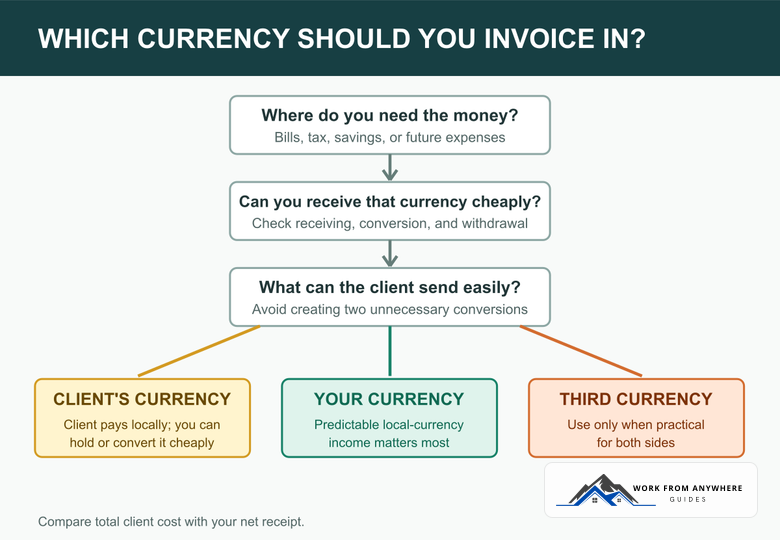
There is no universally best invoice currency. The sensible choice depends on who can hold the currency, who pays for conversion, what the client can send easily, and which currency you use for expenses and taxes.
| Invoice option | When it can work | Main risk |
|---|---|---|
| Client's currency | The client can pay locally and you have an inexpensive way to receive or hold it | You carry the conversion risk and may receive less in your home currency |
| Your home currency | You want a predictable local-currency amount | The client may face conversion costs or reject an unfamiliar payment route |
| A third currency such as USD or EUR | Both sides commonly use it and the contract explains fees and conversion | Both sides may still need to convert, creating two sets of costs |
Ask two practical questions before choosing: “How much will the client pay in total?” and “How much will reach me in the currency I use?” A route that is cheap for you but expensive or awkward for the client may slow payment.
For a project lasting several months, write the currency into the proposal and contract. If you quote “1,000” without saying USD, CAD, AUD, EUR, or another currency, you have not agreed on a price.
Provider pricing is hard to compare because one service may show a transfer fee while another earns part of its cost through the exchange rate. Use the same invoice amount, sender country, recipient country, payment method, and destination currency for every comparison.
Record these figures:
The winner is not always the provider with the lowest advertised percentage. A slower bank route may cost less but create cash-flow trouble. Card payments may be easier for a new client but cost more and carry chargeback risk.
Use official pricing pages as the starting point, then check the quote inside your own account. Availability and pricing can differ by region.
These services are examples, not a ranking or personal recommendation. Check whether the provider operates in your country, supports your business type, pays out to your bank, and gives you documents suitable for accounting.
“The client pays the fee” is too vague because several organizations may charge something. Your contract or invoice terms should answer:
You cannot always pass every cost to the client. In some places or payment arrangements, surcharging may be restricted. Often the cleaner approach is to include ordinary payment costs in your pricing and charge separately only for an unusual route requested by the client.
State the arrangement before sending the final invoice. A clear freelance proposal should already identify the price, currency, payment schedule, and assumptions that could change the quote.
A multi-currency account may let you receive and hold a client's currency before converting it. That can prevent an automatic conversion and give you control over timing. It does not guarantee that waiting will improve the rate.
If you need the money for rent, tax, or business expenses, convert enough to meet those commitments. For the remainder, use a simple policy rather than trying to predict the market:
Check how the account safeguards customer funds, whether balances earn anything, what happens if the provider restricts the account, and whether local deposit insurance applies. A payment account is not automatically the same as a bank account.
A fixed quote can lose value while you wait for a long project to finish. You do not need a complicated financial product to handle most freelance jobs. Use shorter milestones, deposits, and a quote-validity period.
For example:
This quote is in EUR and is valid for 14 days. The project begins after the first milestone is funded. Additional work will be quoted separately in EUR.
For a multi-month retainer, review the price at a stated interval rather than changing it after every currency move. If the exchange rate changes enough to make the work unprofitable, discuss the next renewal before continuing. Do not surprise the client with a different amount on an invoice that was already agreed.
Clear milestone and payment terms also make it easier to spot the client red flags that matter before accepting a project.
For each international payment, save:
Your tax authority may require foreign income and deductible fees to be converted using a particular rate or date. The rule can depend on where you live, your accounting method, and your business structure. Use the relevant tax authority's current guidance or an accountant rather than choosing whichever rate gives the best result.
The site's guide to remote-work tax questions for 2026 can help you identify what needs checking, but it is not a substitute for local advice.
You can adapt this short policy for proposals and contracts:
Invoices are issued in [currency]. Payment is due within [number] days through [approved methods]. The quoted price includes normal receiving costs through [preferred method]. If the client requests another payment route, any additional processing or intermediary fees will be agreed before payment. Work begins after the first milestone is funded.
Then explain the policy during the project kickoff rather than waiting for payment to become awkward. The same direct approach used in good client communication works here: name the currency, amount, route, deadline, and next action.
Your rate should reflect the work, business costs, experience, risk, and value of the deliverable. International payment costs belong in that calculation, but they are not a reason to guess what a client can afford based only on location.
Before your next international invoice, run one real quote from the client's payment method through to your bank currency. Record the exchange rate, every fee, and the amount you would actually receive. Then put the currency, payment route, and fee arrangement in writing before the work begins.



Use this freelance contract checklist to clarify scope, revisions, payment, ownership, confidentiality, delays, and project cancellation.
Compare freelance payment methods by country support, client convenience, total fees, currency conversion, withdrawal, and payment risk.
Leave a Reply
Comments