Freelance Contract Checklist: Scope, Payment, Revisions, and IP
Use this freelance contract checklist to clarify scope, revisions, payment, ownership, confidentiality, delays, and project cancellation.

Freelance client red flags include vague scope, payment pressure, free work, and suspicious access requests. Learn how to screen projects before saying yes.

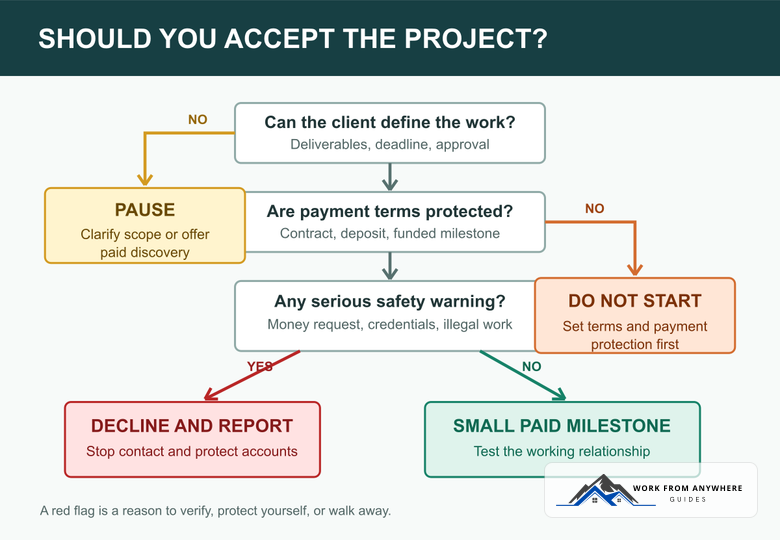
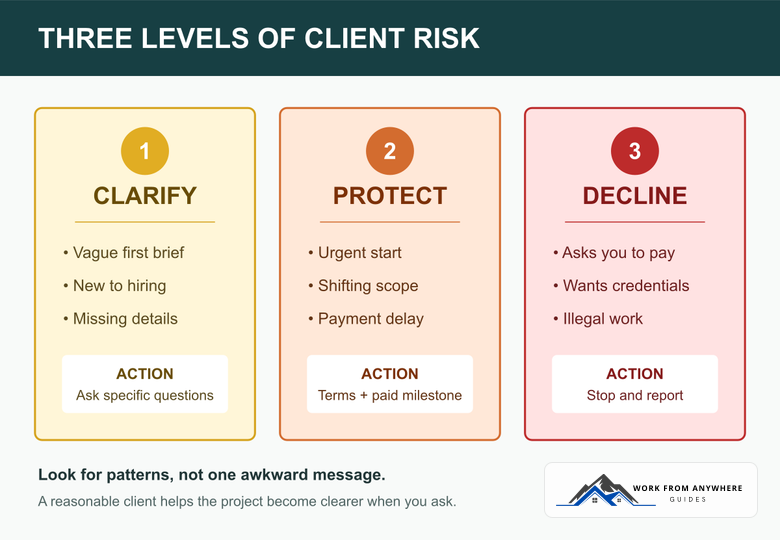
Not every difficult client is a scammer, and not every vague project is doomed. Some clients are simply new to hiring freelancers or still working out what they need. A red flag means you should ask another question, reduce the first milestone, or verify something before committing your time.
Look for patterns rather than one awkward message. A client who gives an unclear brief but answers your questions thoughtfully may be fine. A client who stays vague, refuses a contract, pressures you to start, and avoids payment details is showing a much riskier pattern.
You do not need perfect answers to every question. You do need enough clarity to understand what you are accepting and how you will be paid.
“I need help with marketing” may be a reasonable opening message. It is not a workable project scope. Before accepting, ask what needs to be delivered, who it is for, what already exists, when it is needed, and how the client will approve it.
The warning sign is not initial uncertainty. It is resistance to useful questions. A risky client may insist that the job is simple while refusing to define it, then expect every related task to be included later.
Reply with a small written scope:
Based on our discussion, I would deliver an audit of the five listed pages and a prioritized action plan. Implementation and ongoing reporting are not included. Please confirm that this matches what you need.
If the client will not confirm the basic deliverables, do not quote a fixed price. Offer a paid discovery stage or decline the project.
A low budget is not automatically a red flag. A small business may have limited funds and be willing to reduce the scope. The problem is a client who wants strategy, execution, several specialist roles, immediate availability, and unlimited revisions for the price of one small task.
Do not argue about whether the client’s budget is fair. Explain what you can deliver within it:
That budget would cover one landing-page review with written recommendations. The full redesign and implementation would need a separate estimate.
If every attempt to reduce the scope is met with more demands, the project is unlikely to become easier after you accept it.
A short conversation, relevant portfolio sample, or explanation of your approach is normal. Producing a finished logo, complete article, campaign plan, or working feature “as a test” transfers the client’s hiring cost to the freelancer.
If the client genuinely needs to compare how candidates handle the work, suggest a small paid test with the same terms for everyone. Do not provide the core deliverable and hope the client pays later.
You can still demonstrate your thinking in a strong freelance proposal. Name the problem, show relevant proof, and outline the first steps without completing the project for free.
Before beginning, agree on the price, currency, payment method, due dates, and what triggers each payment. Direct projects may use a deposit and milestone schedule. Marketplace projects should use the platform’s funded milestone or protected hourly process.
Be cautious when a client says accounting is busy, the payment system is almost ready, or you should begin because the deadline is urgent. A genuine administrative delay can happen, but it does not require you to carry all the risk. Move the start date until the agreed payment protection is in place.
On Upwork, an unverified billing method can affect eligibility for hourly protection. Its current guidance tells freelancers not to work on a paused contract and warns against moving payment outside the platform to bypass the pause. Check the rules for whichever freelance job board or platform you use because protections differ.
A client should not need you to send money to receive work. Requests to pay an application fee, purchase gift cards, deposit a check and return the extra amount, transfer cryptocurrency, or buy equipment from a specified supplier are serious warnings.
The US Federal Trade Commission’s work-from-home scam guidance specifically warns about fake employers who send checks for equipment and then ask the recipient to return money. A bank may initially show the funds as available before discovering that the check is fake.
Do not forward money or goods for a stranger. Verify the company using contact information you find independently, not the phone number or link in the suspicious message. Report the account to the platform and the appropriate fraud authority in your country.
A client may prefer email or another tool after a contract begins, but pressure to move communication or payment before hiring can remove platform protection and may violate its rules. The scammer’s goal is often to get you somewhere the original platform cannot review the messages or transaction.
Upwork’s safety guidance, for example, says users should keep pre-contract communication and payment on the platform and report requests for money, free work, checks, or personal information.
Follow the current rules of the platform you are using. Do not assume that a friendly client asking for WhatsApp or direct payment understands, or cares about, the risk to your account.
Scammers sometimes use the name of a real company or employee. A professional logo, polished website, or familiar brand name is not proof that the person messaging you represents that business.
Check the sender’s email domain carefully. Search for the company independently, verify that the role or project makes sense, and contact the company through a known official channel when necessary. Look for inconsistencies in names, locations, job details, and payment instructions.
Do not share identity documents, tax numbers, banking credentials, or account passwords just because someone says they need them to prepare an offer. Legitimate contracts and tax processes can require personal information, but first verify who is requesting it, why it is required, how it will be stored, and whether a safer method is available.
A genuine emergency project can be worth accepting when the scope is clear and the rush fee reflects the disruption. Constant urgency is different. The client may want an immediate call, a same-day start, frequent replies at all hours, and a deadline that ignores the time needed for feedback or testing.
Pressure can stop you from checking the contract, verifying payment, or thinking through the scope. Slow the process down:
I can begin on Tuesday after the agreement is signed and the first milestone is funded. The earliest responsible delivery date is Friday.
If the project only works when you skip normal safeguards, it does not work.
Direct feedback is part of freelance work. Insults, threats, discrimination, repeated shouting, or attempts to make you feel guilty for asking about payment are not. Pay attention to how the client talks about previous freelancers too. If everyone before you was supposedly incompetent or dishonest, you may soon join that story.
Set a calm boundary once. Bring the conversation back to the deliverable, agreement, and next decision. The examples in this guide to client communication for freelancers can help you make expectations and difficult updates clearer. If the behavior continues, declining before the contract is easier than trying to repair the relationship halfway through the work.
Projects change. A reasonable client will discuss how a change affects the price and timeline. A risky client treats every new idea as something you already promised.
After each important discussion, send a written summary. When a request falls outside the agreement, state the impact before doing it:
Adding the second audience requires a separate version of the page. I can add that for [price], which would move delivery to [date]. The original scope and date remain available if you prefer.
A written change process is useful even with excellent clients. Refusal to acknowledge any limit is the warning sign, and vague scope is one of the recurring problems covered in these lessons from freelance failures and setbacks.
“We trust each other” is not a replacement for an agreement. Written terms help honest people remember what they decided. They should cover the deliverables, price, payment dates, timeline, revisions, ownership, cancellation, and responsibilities on both sides.
Contracts vary by location and project type, so get appropriate legal advice for valuable or complicated work. For a smaller job, the platform agreement or a simple signed contract may be enough. What matters is that the important terms exist somewhere both parties can review.
A client who refuses all written confirmation while expecting you to reserve time is asking you to absorb avoidable risk.
Do not accept a project that requires fake reviews, plagiarism, academic cheating, phishing, deceptive advertising, unauthorized data collection, impersonation, or access to systems the client does not own. “Everyone does it” does not protect your reputation, platform account, or legal position.
Ask how data, images, contact lists, and source material were obtained. If the answer is unclear, do not assume permission exists. A well-paying project can still be a bad project.
You do not owe a long investigation or accusation. Keep the message short and final:
Thanks for considering me. I’m not able to take this project under the proposed terms, so I’ll step back. I wish you well with it.
If you would accept with one change, state it clearly:
I can take this on once the scope is confirmed and the first milestone is funded. If that arrangement does not work for you, I understand.
Do not keep negotiating with someone asking for money, credentials, illegal work, or suspicious transfers. Stop contact, preserve the messages, secure any account you exposed, and report the activity.
Sometimes the client is real and the project is promising, but neither side has enough experience with the other. A small paid first milestone can test communication, feedback, and payment without committing to the entire engagement.
Choose a piece of work that has value on its own, define the acceptance criteria, and keep it proportional. After it is completed and paid, both sides can decide whether to continue. This is more useful than ignoring doubts or treating every imperfect brief as a scam.
A good project does not need to be perfect, but it should become clearer as you ask sensible questions. Verify the client, put the scope and payment terms in writing, and use a small paid milestone when uncertainty remains. Walking away from one risky project leaves room for work built on clearer expectations.


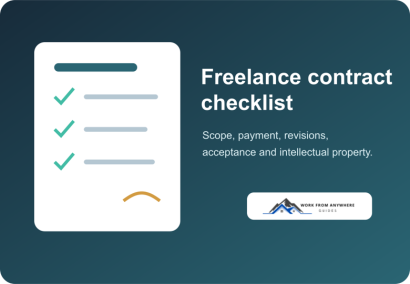
Use this freelance contract checklist to clarify scope, revisions, payment, ownership, confidentiality, delays, and project cancellation.
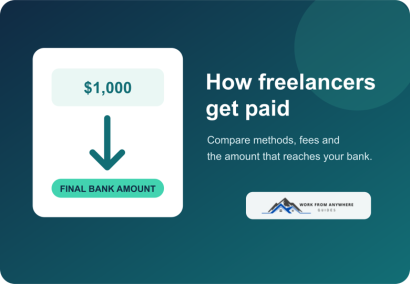
Compare freelance payment methods by country support, client convenience, total fees, currency conversion, withdrawal, and payment risk.
Leave a Reply
Comments