Freelance Contract Checklist: Scope, Payment, Revisions, and IP
Use this freelance contract checklist to clarify scope, revisions, payment, ownership, confidentiality, delays, and project cancellation.

A freelance proposal gets replies when it shows you understand the job, connects your experience to the problem, and makes the next step easy.
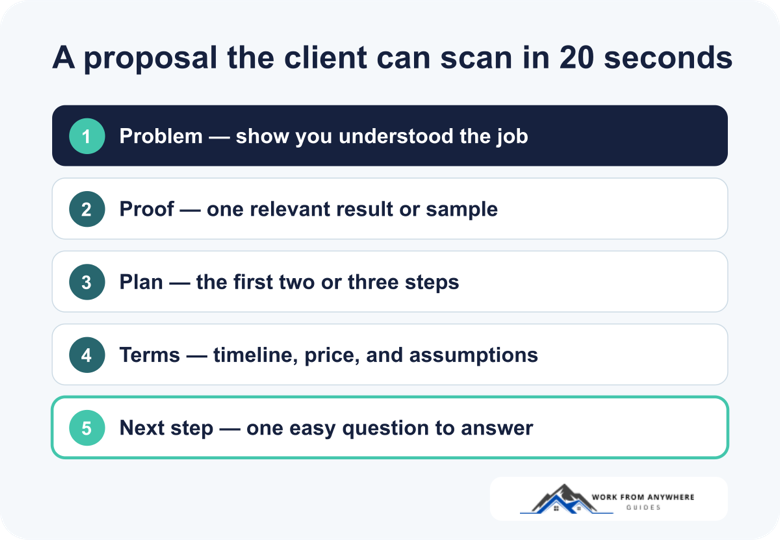
Clients usually open a proposal because they want one question answered: does this person understand what I need? They do not need your full career history in the first paragraph. They need a reason to believe you can handle this particular project.
That is why a short, specific proposal often beats a long polished one. It connects the brief to relevant proof, explains how you would approach the work, and makes the next step easy. Everything else is optional.
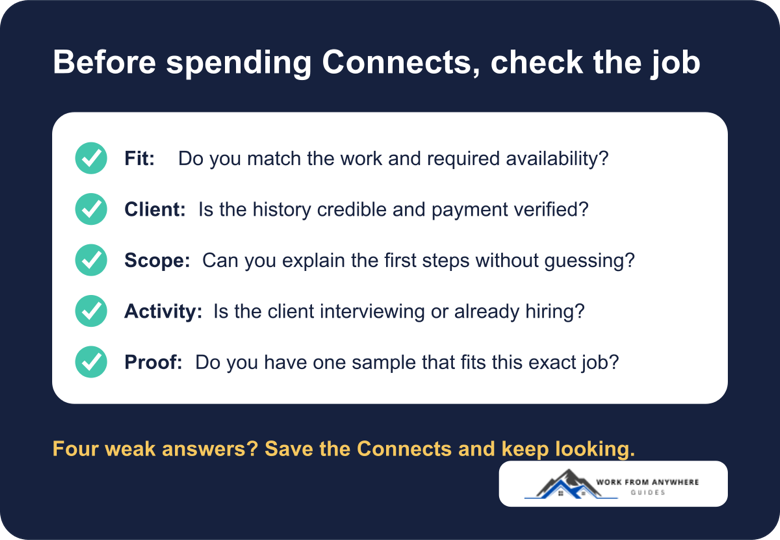
A better proposal cannot rescue a bad-fit project. Before writing, check whether the client has described a real problem, whether your experience is relevant, and whether the budget is at least close to workable. If the brief is vague, you should still be able to identify a useful question to ask.
Skip a listing when the client wants several specialist jobs for one tiny budget, asks for free completed work, or cannot explain what success looks like. You are not losing an opportunity by avoiding a project that was unlikely to work.
This matters on busy freelance job boards and platforms, where it is easy to spend an evening sending proposals simply because the listings are there. Ten rushed applications are not automatically better than three serious ones.
"Dear Sir or Madam, I hope you are doing well" takes up the most valuable part of the proposal without telling the client anything useful. A polite greeting is fine, but get to the work quickly.
A stronger opening shows that you read the brief:
Your landing page explains the product clearly, but the call to action gets buried under three competing offers. I would start by choosing one primary action and rebuilding the copy around it.
This does not pretend you know everything from a short job post. It simply names the problem you see and gives the client something concrete to respond to.
A client hiring an email writer does not need to hear about every blog post you have written. Pick one or two examples that are close to the requested work. Explain what you were responsible for, what constraint you worked under, and what changed.
If you have a measured result, use it. If you do not, do not invent one. You can still describe useful proof:
New freelancers can use self-initiated samples, volunteer work, or a realistic demonstration project. Be honest about what it is. A thoughtful sample made for an imaginary client is more useful than pretending you completed paid work that never happened.
Do not solve the entire project for free inside the proposal. Give enough detail to show how you think, while keeping the actual work for the contract.
For example:
I would handle this in three stages: review the existing pages and analytics, agree on the page hierarchy, then write the first two pages as a style reference before completing the rest.
A small plan makes the project feel manageable. It also exposes misunderstandings early. The client may tell you that analytics are unavailable or that one page needs to launch first. That is useful information before you agree on scope.
If the listing asks for availability, turnaround time, samples, or a specific tool, answer those points directly. Clients should not have to search through your profile to find basic information they requested.
Be clear about time zones without making them a problem. You might write:
I work from Pakistan Standard Time and can keep a two-hour overlap with your morning. I send written updates, so decisions do not depend on both of us being online.
That is more reassuring than saying you are "available anytime." It gives the client a realistic communication pattern and shows that you have worked remotely before.
Your proposal does not need a defensive paragraph explaining why you charge your rate. State the price or estimate, say what it covers, and mention any assumption that could change it.
My estimate is $900 for the five pages described, including one revision round. I am assuming the research and product screenshots are ready. If those still need to be created, I can price that separately.
This protects both sides. The client can compare a real scope rather than a number floating without context. It also reduces the chance that "a few pages" turns into strategy, research, writing, uploading, and unlimited revisions.
Before you send the quote: Use the freelance project calculator to account for estimated hours, your target hourly rate, project costs, a revision buffer, and the platform and payment fees you enter. It gives you a working estimate to review, not a rule for what every client should pay.
Do not close with a vague line such as "I look forward to hearing from you." Give the client a simple action:
One clear next step is enough. A proposal with five questions can feel like homework before the client has decided whether to speak with you.
Use this as a structure, not a script. Replace every bracket with something specific to the project and delete any line that does not help.
Hi [client name],
I noticed that [specific problem or goal from the brief]. I would start by [short, relevant observation or approach].
I recently worked on [similar type of project], where I was responsible for [your role or useful result]. You can see the most relevant example here: [link].
For your project, I would:
1. [first useful step]
2. [second useful step]
3. [delivery or review step]My estimate is [price or range] for [clear scope], and I can deliver the first milestone by [realistic date].
One question before I confirm the scope: [one question that affects the work]?
Best,
[your name]
On Upwork, sending a proposal normally uses Connects, and the amount can vary by job. That is another reason to stop applying to weak matches. Before spending them, check the client’s hiring history, the number of proposals and interviews, whether the scope fits your skills, and whether you have time to write something specific.
Upwork’s current submission flow can include your terms, timeline, cover letter, screening questions, and relevant profile highlights or work samples. Some jobs may use a recorded AI interview instead of a normal cover letter. Treat every required field as part of one proposal. Do not write a careful opening and then paste vague answers into the screening questions.
Upwork’s official proposal guide recommends describing what you can do, asking project questions, suggesting a next step, and showing relevant work. Its Connects guidance also recommends checking client history and job activity before applying.
These are fictional examples, not proposals claimed to have won real contracts. Use their structure and level of detail. Do not copy the wording into unrelated jobs.
Job requirement: Diagnose a mobile checkout that loads slowly and sometimes blocks the payment button.
Weak opening: I am an expert WordPress developer with eight years of experience and can fix all website problems quickly.
Stronger proposal:
Hi Maya,
A mobile-only checkout failure is usually easier to fix after reproducing the exact device and browser path. I would first check the browser errors, layout overlays, payment scripts, and recent plugin or theme changes before touching production code.
I have handled WordPress maintenance where the main constraint was fixing a live sales path without breaking desktop checkout. I can start with a staging copy, document the cause, and give you the proposed change before deployment.
For the first milestone I would:
1. Reproduce and record the issue on the affected devices.
2. Isolate the conflicting script, plugin, or layout rule.
3. Apply and test the smallest safe fix on staging.
4. Deploy during an agreed low-traffic window.Can you share the affected phone/browser combinations and whether this began after a recent update?
Best,
[Name]
Why it works: It names a diagnostic path, protects the live checkout, and asks for information that changes the work.
Job requirement: Write four practical articles for small-business owners comparing payroll features without sounding like product documentation.
Weak opening: I can write high-quality SEO content on any subject and guarantee original, engaging articles.
Stronger proposal:
Hi Daniel,
Your readers probably do not need another list of payroll features. They need to understand what happens when an employee starts mid-month, a contractor is paid in another currency, or a tax deadline is missed.
I write practical software content for non-technical readers. For this series, I would map each article to one business decision, confirm the product claims against current documentation, and use short examples instead of repeating vendor copy.
I can deliver the outline and first article within four working days. My estimate covers four articles, one revision round, and source links. Before I confirm it, are the target products already selected, and will I have access to the software or approved screenshots?
Best,
[Name]
Why it works: It identifies the audience, explains the research standard, gives a first milestone, and exposes a scope question.
Job requirement: Design social graphics for a monthly webinar across LinkedIn, Instagram, and email.
Weak opening: I am proficient in Photoshop, Illustrator, and Canva and can create beautiful professional designs.
Stronger proposal:
Hi Aisha,
The main design problem is consistency across formats. I would create one approved visual system first, then adapt it so the speaker, date, and call to action stay readable on LinkedIn, Instagram, and email.
The closest portfolio sample is [link], where I built a repeatable campaign layout rather than designing every post from scratch. For your webinar, I would deliver a mood direction, three key formats, and an editable template for future months.
My estimate includes two initial directions and one revision round. Do you already have brand typefaces, speaker photos, and a safe area requirement for each platform?
Best,
[Name]
Why it works: It sells a reusable system, points to one relevant sample, and defines what the estimate includes.
Job requirement: Manage an inbox, update a CRM, arrange calls across time zones, and follow up on missing client information for ten hours per week.
Weak opening: I am a hardworking virtual assistant who can handle email, data entry, scheduling, social media, and any other task you need.
Stronger proposal:
Hi Chris,
Your brief describes one connected workflow: a client email creates a follow-up, the CRM records the decision, and the calendar holds the next commitment. I would keep those three places aligned instead of treating inbox, CRM, and scheduling as separate jobs.
For the first week, I would document your priority rules, create labels for action and waiting items, clean the current follow-up list, and send a short daily exception report. Routine updates can stay asynchronous; urgent items can use the channel you approve.
I can provide a two-hour overlap with your morning and handle the remaining work asynchronously. Which CRM do you use, and what should count as urgent enough to interrupt you?
Best,
[Name]
Why it works: It connects the tools into a workflow, proposes a realistic first week, and defines communication boundaries.
Upwork lets eligible freelancers spend extra Connects to boost a proposal, but boosting is optional. Visibility cannot repair a poor match, generic opening, unrelated sample, or unsustainable price. Write the proposal first. If it is not strong enough to send normally, it is not strong enough to boost.
Keep pre-contract communication inside Upwork’s allowed tools and follow the current platform rules. Features, Connects requirements, and proposal steps can change, so check the job screen and Upwork Help before applying.
These are also common early-career problems. Our guide to freelance failures and setbacks covers what to do when a project or client relationship goes wrong.
If the platform allows it and the client has not closed the project, one short follow-up is reasonable. Wait a few business days and add something useful rather than writing "just checking in."
I had one additional thought after reviewing the brief: the onboarding email may be the best first milestone because it will set the tone for the rest of the sequence. I am still available if you would like to discuss it.
Then leave it. Repeated messages do not turn a poor fit into a good one.
Keep a simple spreadsheet with the project type, platform, date, price, proposal angle, reply, interview, and result. After twenty serious proposals, patterns usually become clearer. You may learn that one portfolio sample gets replies, one service attracts unrealistic budgets, or proposals sent to detailed briefs perform better.
Do not change everything after two rejections. Test one improvement at a time: a more specific opening, better sample selection, a clearer scope, or a different type of project. The point is to learn which clients and work fit you, not to find a sentence that manipulates everyone into replying.
For your next application, do not start by polishing a reusable sales pitch. Read the brief once for the problem, choose one relevant proof point, outline a sensible first step, and ask one question that affects the work.
Send fewer proposals you would genuinely be happy to win. That gives you more time to understand the client, price the scope properly, and write something worth replying to.


Use this freelance contract checklist to clarify scope, revisions, payment, ownership, confidentiality, delays, and project cancellation.
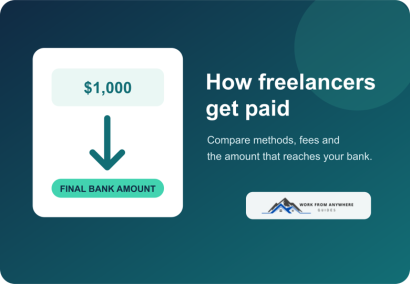
Compare freelance payment methods by country support, client convenience, total fees, currency conversion, withdrawal, and payment risk.
Leave a Reply
Comments