Can You Work Remotely From Another Country? Check These Rules First
Before working remotely from another country, check immigration, employer approval, taxes, social security, data access, and insurance.

The short answer
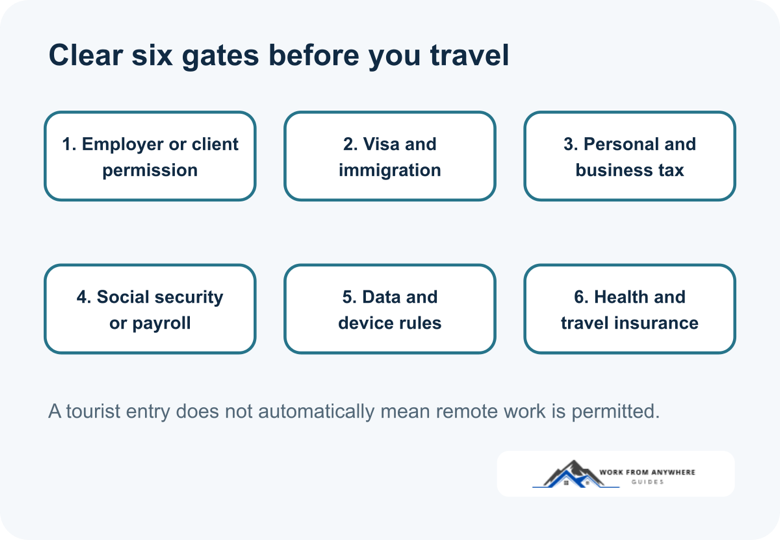
You may be able to work remotely from another country, but a remote job does not give you automatic permission to work wherever you can open a laptop. You need to check immigration rules, your employer or client agreement, personal tax, employer tax exposure, payroll or social security, data security, and insurance.
A one-week trip, a three-month stay, and a permanent move are not the same arrangement. Country, nationality, employment status, work performed, and length of stay can change the answer.
| Check | Employee | Freelancer | Where to verify |
|---|---|---|---|
| Immigration permission | Does the destination allow your overseas employment activity? | Does it allow self-employed client work? | Destination immigration authority |
| Written approval | Employer, HR, security, and sometimes client approval | Client contract, confidentiality, and location restrictions | Employment policy or client agreement |
| Personal tax | Residence, workdays, payroll, and treaty rules | Residence, source of income, registration, and local tax | Both countries’ tax authorities |
| Business tax | Employer may assess taxable presence | Your company or business may create local obligations | Qualified cross-border adviser |
| Social security | Payroll and coverage certificate may matter | Self-employed contribution rules may matter | Relevant social security institutions |
| Data and insurance | Company devices, client data, healthcare, and liability | Client data, equipment, health, and professional cover | Security team, client, and insurer |
Start with permission, not plane tickets
If you are an employee, ask for written approval before booking. Your manager saying “work from anywhere” in a meeting may not override HR, payroll, tax, security, insurance, export-control, or client-contract restrictions. Give the employer the country, exact dates, address type, work activities, and whether you will meet customers or local colleagues.
If you are a freelancer, check each contract for location, confidentiality, data-processing, insurance, and subcontracting limits. A client may allow remote delivery but prohibit access to its systems or personal data from specific countries.
A tourist visit is not a universal remote-work permit
Immigration rules define what visitors may do. They are not identical across countries, and the label “digital nomad” does not create a global legal category. Some destinations offer digital-nomad or remote-work visas. Others allow limited incidental remote activity during a genuine visit. Others can treat productive work as work that needs permission.
The United Kingdom shows why details matter. Its visitor rules allow activities related to overseas employment to be done remotely only when remote work is not the primary purpose of the visit. That is a UK rule, not a worldwide rule and not permission to assume the same thing elsewhere.
Check the destination government’s immigration site for your nationality and planned activity. If the wording is unclear, ask the authority or a qualified immigration adviser. Do not rely on a travel forum post written for another passport.
Count workdays and travel days
Keep a simple day log with the country, arrival and departure, whether you worked, and the employer or client served. Tax residence often considers physical presence, but the common “183-day rule” is not a universal safe harbour. Domestic rules, tax treaties, permanent homes, personal ties, and where work is physically performed can all matter.
The EU’s Your Europe guidance says there are no single EU-wide income-tax rules for people living and working across countries. It notes that spending more than six months in another EU country will usually make you tax-resident there, while also warning that each country defines residence and treaties can change the result. That is a starting point, not a shortcut.
Read the existing guide to remote-work taxes, then confirm the current rules with the tax authorities for both countries or an adviser who handles the specific pair.
Your employer can have a tax problem even when you do not
Cross-border work can affect an employer’s payroll, withholding, social contributions, corporate tax, and reporting. The OECD’s 2025 Model Tax Convention update added guidance on when a home office in another country may create a taxable business presence. The OECD says working abroad from home does not automatically create that presence, but the amount of work and whether the location serves a commercial purpose can matter.
This is one reason employers set day limits or approved-country lists. The policy is not necessarily about mistrust. It may be the company’s way of controlling obligations it cannot assess trip by trip.
Social security and healthcare are separate checks
Income tax does not answer social-security coverage. Within the EU, Iceland, Liechtenstein, Norway, and Switzerland, official guidance says a person is generally subject to one country’s legislation, with specific rules for posted workers and people working in more than one country. Certificates of coverage may be relevant.
Outside those systems, bilateral agreements and domestic rules vary. Employer health insurance may exclude non-emergency care abroad or have conditions for longer stays. Travel insurance can exclude routine work, equipment, pre-existing conditions, or trips that exceed a stated duration. Ask the insurer in writing what the policy covers while you are working.
Remote access can break a client promise
Working from another country changes the network, physical environment, and sometimes the legal location of data access. Confirm whether client or company rules permit access from that country. Use the approved device, multi-factor authentication, full-disk encryption, current updates, and the company VPN when required.
Avoid confidential calls in shared accommodation. Do not leave equipment visible in a rental or coworking space. Keep recovery codes and backup access separate from the laptop. The guide to digital safety tools for remote workers covers the basic setup.
Three trips that need different decisions
A one-week holiday with two emergency check-ins
The work may be incidental, but you still need employer approval, immigration confirmation, secure access, and an accurate day log. Do not turn “I may answer one urgent message” into a normal workweek without revisiting the plan.
One month working normal hours from a rental
Remote work is now a central purpose of the stay. Immigration permission, employer tax review, payroll or social-security checks, insurance, working hours, and client data location deserve a formal answer before booking.
A move with no fixed return date
Treat this as relocation, not travel. Expect deeper questions about residence permission, tax residence, local registration, employer entity or payroll, healthcare, banking, and whether the employment or client arrangement can continue legally.
A request you can send to your employer
I would like approval to work from [country] from [date] through [date]. I will work from [type of location], keep my normal [time zone] overlap, and will not meet local customers or perform local sales unless separately approved. I will use the company device, MFA, and required VPN. Please confirm whether HR, payroll, tax, security, insurance, or client approval is also required before I book.
For a client, replace the employment-policy language with the systems and data you will access, the delivery schedule, time-zone overlap, and the country where the work will be performed.
Decision checklist before booking
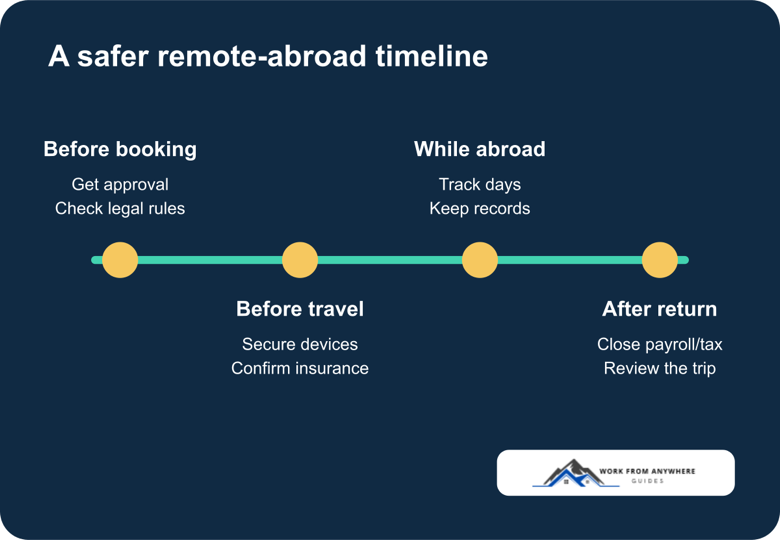
- Write down the exact country, dates, work activities, employer or clients, and systems accessed.
- Get employer or client permission in writing.
- Confirm immigration permission with the destination authority.
- Check personal tax, employer or business tax, payroll, and social-security questions.
- Confirm healthcare, travel, equipment, and professional insurance.
- Agree on working hours, urgent contact, and data-security controls.
- Keep a country-by-country day log and copies of approvals.
Official sources checked
Do not treat a remote job as permission to work from every country. Write down the exact place, dates, and work, then clear each immigration, employer, tax, security, and insurance question before you book.
Leave a Reply
Comments