Blockchain for Remote Workers: Practical Uses, Risks, and What Actually Helps
Blockchain can help remote workers with payments, escrow, contracts, and credentials, but it also brings scams, fees, volatility, and tax work.

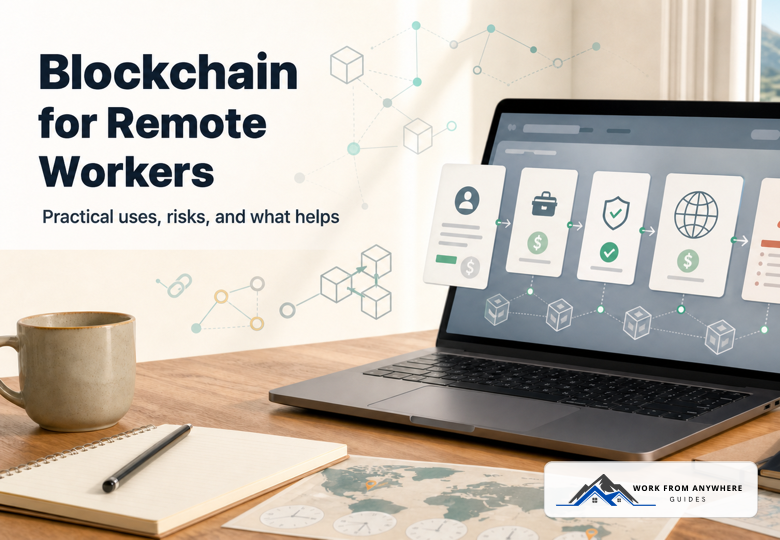
Where blockchain can actually help remote workers
The strongest use case is cross-border payment. If you work with clients in countries where bank transfers are slow, expensive, or unreliable, a blockchain payment can move value faster than a traditional wire. Stablecoins are especially common here because they are designed to track a currency like the U.S. dollar, which avoids some of the wild price swings that come with many cryptocurrencies.
That does not mean it is automatically cheaper. Network fees, exchange fees, withdrawal fees, and currency conversion can still add up. Before accepting a blockchain payment, compare the full path: what the client sends, what lands in your wallet, what it costs to convert, and what reaches your bank account.
Smart contracts and escrow can reduce payment anxiety
Freelancers know the uncomfortable part of remote work: you send the work, then hope the client pays. Escrow exists to solve that. A smart contract can act like automated escrow, where funds are released when agreed conditions are met.
In theory, that is useful. In practice, it depends on the platform and the agreement. A smart contract is only as good as the rules written into it. If the project scope is vague, the contract will not magically understand whether the client is being unfair or the freelancer missed the brief.
Use escrow or smart contracts for clear deliverables: a design file, a code milestone, a published article, a fixed consulting session. Avoid using them as a substitute for a proper scope of work.
Credentials and proof of work are promising, but still early
Blockchain can also be used for verifiable credentials: certificates, work history, course completions, or proof that a portfolio item belongs to you. For remote workers who move between platforms and clients, portable proof could be useful.
The catch is adoption. A credential is only valuable if clients, platforms, or employers recognize it. Do not pay for a blockchain certificate just because it sounds official. Ask who accepts it, how it can be verified, and whether it helps you win work.
What blockchain does not fix
Blockchain does not make a bad client trustworthy. It does not make vague contracts clear. It does not remove the need for invoices, taxes, records, or communication. It also does not make payments private by default. Many blockchain transactions are visible on public ledgers, even if names are not attached in an obvious way.
It is better to think of blockchain as payment and record infrastructure, not a complete business system. You still need the boring parts: a written agreement, clear milestones, a payment schedule, and a way to resolve disputes.
The risks remote workers should take seriously
The biggest risk is scams. Be careful with any client who insists on crypto only, asks you to pay a fee to unlock a job, sends you to a strange exchange, or promises guaranteed returns. The FTC warns that crypto payments usually do not come with the same protections as credit or debit cards, and once a crypto payment is sent, it is typically not reversible.
The second risk is volatility. If you accept payment in a cryptocurrency that moves sharply, your $1,000 invoice might not be worth $1,000 by the time you convert it. Stablecoins can reduce that risk, but they still depend on the issuer, platform, and market conditions.
The third risk is tax reporting. In the U.S., the IRS treats digital assets as property, and income received for services in digital assets can be taxable. Other countries have their own rules. Keep records of the date, amount, currency, wallet, conversion rate, fees, and final bank deposit.
A simple checklist before accepting blockchain payment
- Confirm the client is real and the work agreement is written down.
- Use a payment method both sides understand.
- Prefer stable payment terms over speculative tokens.
- Calculate all fees before agreeing to the rate.
- Check whether you can convert and withdraw in your country.
- Send a small test transaction before a large payment.
- Keep records for taxes and accounting.
- Never pay a fee to get a job or release a payment.
When blockchain is worth considering
It may be worth considering if you work across borders, your client already uses crypto payments, your local banking options are expensive or slow, or you are using a reputable platform with built-in escrow and clear dispute rules.
It is probably not worth it if the client is pressuring you, the tool is unfamiliar, the fees are unclear, the payment token is volatile, or the whole setup takes more effort than a normal invoice.
Blockchain can help remote workers, but only in specific ways. It can make some international payments faster, support escrow-like agreements, and create portable records. It can also expose you to scams, irreversible mistakes, price swings, and tax paperwork.
Use it like a tool, not a belief system. If it makes payment faster, safer, or easier for a real project, it may be useful. If it adds confusion, pressure, or risk, choose the boring payment method and get back to the work.


Leave a Reply
Comments